Where the Earth Meets the Sky – The Story of Mount Yengo
Inland from the beaches of the New South Wales Central Coast, the land rises into a country of sandstone ridges and deep, shadowed gullies. Here, in the hinterland beyond Wollombi, grey-barked angophoras twist from the rock. Creeks run tea-dark over sandstone beds, and in the early morning a thin mist lies in the valleys like breath. Lyrebirds scratch in the leaf litter, and a wedge-tailed eagle turns slow circles above the escarpment.
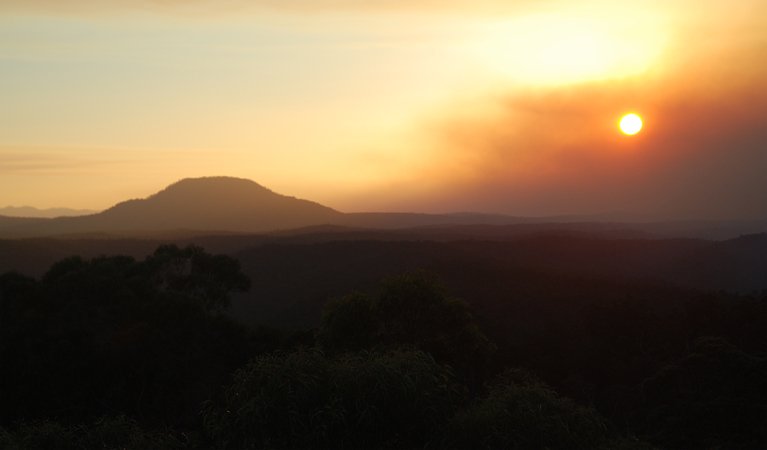
This is the Country of the Darkinjung and Wonnarua peoples, who have cared for it for tens of thousands of years. To them, this landscape is far more than scenery. It is a living story, written into rock and river, and one of its most important chapters is marked by a mountain whose summit looks as though it has been pressed flat by a giant hand.
That mountain is Mount Yengo, and the story is Biaime’s.
Biaime’s Creation of the Land
In the beginning, before the rivers had found their courses and before the ridges had taken their shape, the great ancestral creator Biaime (also spelled Baiame) walked the earth.
Where Biaime stepped, the land answered. He pressed his heel into soft ground, and valleys opened. He drew his hand across the plains, and hills rose behind it like waves frozen in stone. He sang, and water began to move. It trickled at first, then gathered and ran, cutting channels through the country until the rivers wound down toward the sea.
He shaped the sandstone into cliffs and caves where people could shelter. He filled the forests with wallaby and possum, the waters with eel and fish, and the air with birdsong. Nothing he made was made by accident. Every creek and ridge had its place and its purpose, and each was bound to the others in a pattern of relationship.
Biaime’s work was not only the shaping of rock and soil. As the land took form, it was filled with spirit. The ancestral beings moved through it and left their presence in waterholes, rock shelters, and the high places. Biaime gave the people Law: how to live with the land, how to care for it, and how to care for one another. Earth and spirit were woven together, and the Country became alive in every sense.
The Need to Return to the Sky Country
Above the earth lies another realm: the Sky Country. It is the home of the spirits and the ancestors, a place of great power that watches over the world below. The stars that burn over the ranges at night are part of it, and so is the vast dark between them.
When Biaime’s work was done, when the mountains stood firm and the rivers ran true and the people understood the Law, his time on earth came to an end. He was not abandoning the land he had made. His journey was part of a great cycle, the movement of spirit from earth to sky and back again, which the people would also follow in their own time.
Biaime chose his path home carefully. He would leave from a high place, where the ground reached closest to the heavens.
The Leap from Mount Yengo
Biaime walked to Mount Yengo. He climbed its slopes through the scrub and stone until he stood at the summit. From there he could see everything he had made: ridge after ridge folding away into blue distance, the green threads of the river valleys, and the far shimmer of the coast.
Then he gathered himself and leapt.
The force of that leap was so great that the mountain could not hold its shape beneath him. As Biaime pushed off from the earth, his weight pressed the peak down, flattening its summit. He rose into the sky and passed into the spirit world, and the mountain below kept the mark of his going.
To this day Mount Yengo’s flat top stands out against the skyline. It is Biaime’s last footprint on earth, a lasting sign of the moment the creator left the world he had shaped and returned to Sky Country.
Cultural and Spiritual Significance
For the Darkinjung and Wonnarua peoples, this story is not a myth from a distant past. It is knowledge that ties people to Country and to their ancestors. When they look at Mount Yengo, they see the evidence of Biaime’s journey, and they are reminded where the Law came from and why the land must be cared for.
The mountain is a meeting place. It stands on the boundary between earth and sky, between the seen and unseen worlds. It shows that the physical landscape and the spiritual realm are not separate. They touch, and in places like Yengo that connection can be felt.
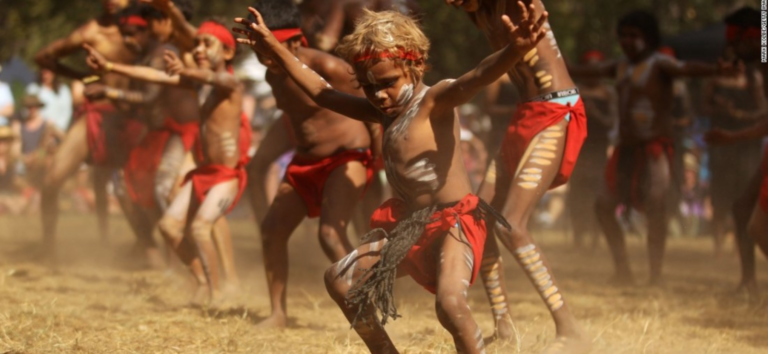
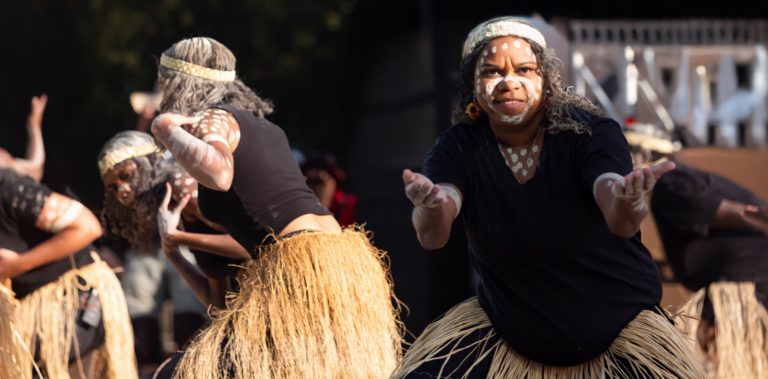
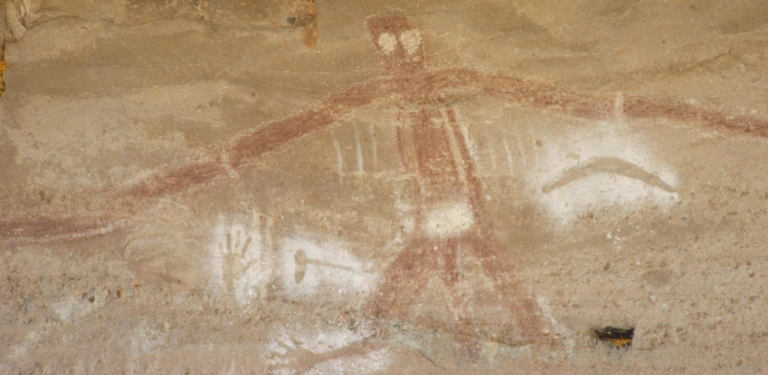
Across the surrounding region, rock engravings and sacred sites record parts of the same spiritual tradition. They include ancestral figures carved into sandstone, and cave art in the Hunter Valley linked to Biaime. The story has been carried through countless generations by elders, in ceremony, song, and the telling of stories on Country. Each telling keeps the knowledge alive: knowledge of the land, of the spirit world, and of how the two are joined.
Contemporary Reflection
Today Mount Yengo lies within Yengo National Park, part of the Greater Blue Mountains World Heritage Area. It is recognised as a place of deep cultural significance, and the wider landscape holds many important Aboriginal sites. Darkinjung and Wonnarua people continue to hold their connection to this Country and to speak for it.
The mountain’s shape brings together ecology, culture, and history in a single view. The same ridges that shelter rare plants and animals also carry the story of creation, and caring for one means caring for the other.
For visitors, this is an invitation to look differently. A walk through these ranges can be an opportunity to recognise that Australia’s landscapes hold the oldest continuing stories on earth, and that learning them, respectfully and from the people who hold them, deepens our understanding of the land itself.
What It Means
The story of Biaime and Mount Yengo explains how a mountain came to have a flat top. It also tells of a creator who shaped the world with purpose, filled it with spirit, and returned to the sky once his work was complete, leaving a mark that would never fade.
Stories like this ground identity and culture in place. They remind us that the land is not empty ground but living Country, and that the relationship between people and place is sacred. When the evening light falls across Yengo’s level summit, it is worth pausing to remember that it is Biaime’s footprint, pressed into the earth as he leapt home to the stars.
Learn more:
- Yengo National Park – NSW National Parks and Wildlife Service
- Darkinjung Local Aboriginal Land Council
This retelling draws on publicly shared accounts of the story. The full depth of this knowledge belongs to the Darkinjung and Wonnarua peoples, and readers are encouraged to seek it from them directly.